
For rooms that reset every week: how to spec carpet that survives chair scuff, cart traffic, and constant spills.
A banquet hall floor sees more chair scuff per square foot than almost any other commercial space. Tables move every event. Chairs drag. Catering carts roll. Coffee spills at every setup. Plenty of commercial carpet that works fine in an office wears through in this environment in three to five years. The right banquet hall and convention center carpet is engineered around that reality. Here’s how to spec it, what to expect to pay at wholesale, and what we’ve learned from event spaces we’ve supplied.
Spec event floors for chair scuff, cart traffic, spills, and fast resets: solution-dyed BCF nylon broadloom at 36 to 42 ounces with a density of 5,000 or higher, on action-back, in a busy mid-scale pattern on a medium-to-dark base. Seal every seam and run seams parallel to the cart lanes. Stock styles usually win under 8,000 square feet; custom earns its keep in large branded venues.
Five operational stresses define banquet hall and convention center flooring, and most carpets fail at least two of them.
The carpet that handles all five has a specific spec, and here’s what it looks like.
The first decision is pattern. For banquet halls and convention centers, busy patterns and mid-to-dark tones outperform solid colors and light tones in every operational dimension. A solid-color carpet shows every chair-scuff mark, every traffic lane, every coffee spill, and every footprint. After two seasons the high-traffic zones read as visibly different from the rest of the room, and after five the room looks tired even with proper cleaning. Light tones make it worse: light beige, cream, and soft gray all amplify wear, while a medium-to-dark base with a multi-color or tonal pattern hides chair scuff and traffic compression for years.
Busy patterns hide spills the same way casino carpet does. A multi-color pattern (geometric, organic, or motion-based) buries a coffee spill long enough for cleanup; a solid color doesn’t. Scale matters too. A pattern that repeats every 12 to 24 inches reads as texture from a distance and hides wear up close. Larger repeats can look broken at column lines and HVAC penetrations, and micro-patterns can read as solid from a distance and lose their wear-hiding benefit.
If a carpet can’t hide a coffee spill until the cleanup crew gets to it, it won’t survive a banquet season.
Most banquet halls and convention centers use broadloom rather than carpet tile, for three reasons:
Tile does make sense in some places, like convention center exhibit halls with cable management needs and smaller event rooms that get reconfigured often. For traditional banquet halls and most carpeted convention center areas, broadloom is the standard. Our carpet tile vs. broadloom guide covers the full comparison.
Banquet halls have one failure mode that comes up more than any other: seam failure under repeated rolling cart traffic. Action-back broadloom with properly sealed seams handles this load fine. When we see failures, they trace back to three install practices:
For more on backing options and how they fail, see our carpet backing guide and our action-back carpet guide.
Here’s the spec we’d recommend for a typical 8,000-square-foot banquet hall expecting 10-plus years of service.
| Spec | Recommendation |
|---|---|
| Format | Broadloom |
| Face weight | 36 to 42 ounces per square yard |
| Density | 5,000 or higher (face weight times 36, divided by pile height) |
| Fiber | Solution-dyed nylon |
| Yarn | Bulked continuous filament (BCF) |
| Pile | Level loop or low cut-and-loop |
| Backing | Woven polypropylene secondary (action-back) |
| Pattern | Mid-scale multi-color or tonal, on a medium-to-dark base |
| Color | Coordinated with the hall’s brand and tested under actual event lighting before you commit |
For a line-by-line walk-through of each spec, see our high-traffic spec guide. Convention centers with mixed exhibit and meeting areas may shift toward heavier face weights (42-plus ounces) and use carpet tile in some zones for cable management. The base spec stays the same: solution-dyed BCF nylon, a busy pattern, and dark-to-mid tones.
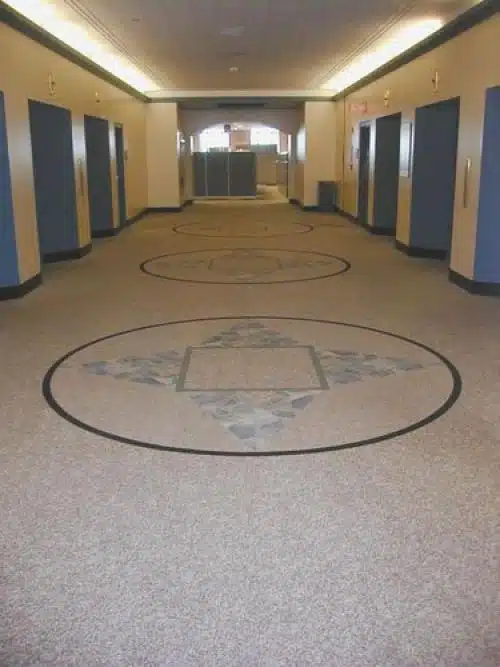
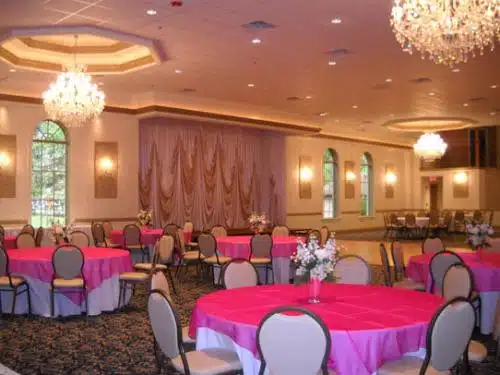
Two event spaces from our completed projects portfolio show the spec logic at work. At the Jacksonville Convention Center, circular medallions inset into a neutral field break up a long elevator corridor and give it a sense of place. At Crystal Grand Banquets in Burbank, Illinois, a dark, busy pattern carries a ballroom that hosts weddings and corporate events, the same spill-hiding approach described above.
Stock commercial broadloom in the spec above typically runs $6 to $12 per square yard at our wholesale pricing, sometimes lower depending on the inventory. Retail-priced equivalents run two to four times higher. An 8,000-square-foot banquet hall needs roughly 900 square yards plus a 15 percent waste factor, which puts material in the $6,000 to $12,000 range at wholesale, plus installation. Installation is local, and subfloor prep is the biggest variable, so get a quote from a commercial installer near the venue.
The mill-direct math changes the conversation on large projects. We buy first-quality overruns, special runs, and discontinued styles directly from the mills here in Dalton, and the savings come from inventory, not defects. Our wholesale buying guide explains how that works.
For convention centers, hotel-attached banquet facilities, and branded venue chains, custom broadloom is worth considering. Custom runs let you build logos, brand colors, or proprietary pattern elements into the carpet itself. Minimums typically run 1,000 to 2,000 square yards depending on the mill and the pattern, and lead times run 8 to 16 weeks. For most banquet halls under 8,000 square feet, stock styles make better economic sense. For convention centers and large hotel-attached venues at 15,000-plus square feet with brand requirements, custom is often worth the conversation. Our guide to custom carpet covers minimums, lead times, and pricing, and our custom-made carpet collection shows the kinds of runs we handle.
We’re a mill-direct wholesaler in Dalton, Georgia, and event-space broadloom is a regular part of what we ship. For stock styles that suit a banquet hall, start with our hospitality carpet collection.
Tell us the room size, the event mix, and the reset schedule, and we’ll match face weight, pattern, and backing to the floor. Order free samples with free shipping and no obligation, or call 706-526-4800 for project pricing on larger orders. Samples ship from Dalton in a few business days.
Solution-dyed BCF nylon broadloom at 36 to 42 ounces per square yard with a density of 5,000 or higher, in a level loop or low cut-and-loop on action-back, with a mid-scale multi-color or tonal pattern on a medium-to-dark base.
Usually broadloom. It gives photographers and cameras a continuous surface, costs less per square foot at banquet-hall sizes, and carries large patterns better. Tile makes sense in exhibit halls with cable management needs and in smaller rooms that get reconfigured often.
Because busy patterns hide chair scuff, traffic lanes, and spills between events. Solid colors and light tones show wear within a couple of seasons. A pattern that repeats every 12 to 24 inches reads as texture from a distance and hides wear up close.
Stock commercial broadloom in a banquet-hall spec typically runs $6 to $12 per square yard at our wholesale pricing. An 8,000-square-foot hall needs roughly 900 square yards plus a 15 percent waste factor, or about $6,000 to $12,000 in material before installation.
Rolling cart traffic is hard on seams, and failures usually trace back to the install: seams that cross the main cart lanes, seams that were never sealed, or the wrong adhesive on a slab with moisture issues.
For convention centers, hotel-attached venues, and branded venue chains, especially at 15,000-plus square feet with brand requirements. Custom minimums typically run 1,000 to 2,000 square yards with 8 to 16 week lead times. Under 8,000 square feet, stock styles usually make better economic sense.
Mill-direct commercial flooring wholesaler in Dalton, GA, the carpet capital of America. First-quality goods at up to 80% off retail, with free samples shipped nationwide. Serving the commercial trade since 2004.